Every year, millions of professionals pack their bags, board flights, and walk into massive convention centers with a singular goal: to meet the right people. Conferences, trade shows, and industry summits represent a massive investment of time, travel expenses, and registration fees. Yet, for decades, the actual process of connecting with other human beings at these events has relied entirely on luck. You sit at a random table for lunch, stand in a long line for coffee, or make awkward small talk in a crowded hallway, hoping that the person next to you shares a mutual business interest. Most of the time, they do not. This old approach treats professional networking as a game of pure chance.
The corporate world is moving away from random chance. High-performing professionals no longer have the patience for inefficient events. This shift is why AI event matchmaking has quickly evolved from an experimental tech trend into the absolute standard for modern business events. By leveraging machine learning, natural language processing, and advanced intent analysis, smart event technology turns large crowds into highly curated spaces. Instead of collecting hundreds of random business cards that end up in a desk drawer, attendees can now use data to ensure every single conversation counts.
This educational guide explores how an AI event matchmaking platform works under the hood, why old-school networking models fail, and how smart data transforms random hallway chats into high-value strategic partnerships.
The Modern Reality: Quality Connections Vs Followers
For years, digital culture conditioned professionals to focus on vanity metrics. Success on standard social networks was measured by the sheer size of your audience: how many followers you had, how many connection requests you accepted, or how many business cards you collected at a mixer. The business world is experiencing a major correction regarding this mindset. The focus has decisively shifted toward a core principle: Quality Connections Vs Followers.
The Professional Network Shift
OLD METRIC: Audience SizeNEW METRIC: Network Signal
Thousands of surface-level digital contacts
Low response rates and high noise levels
Focus on volume over actual business intent
Curated circles with high mutual alignment
Meaningful connections that actively reply
Focus on depth, shared goals, and joint ventures
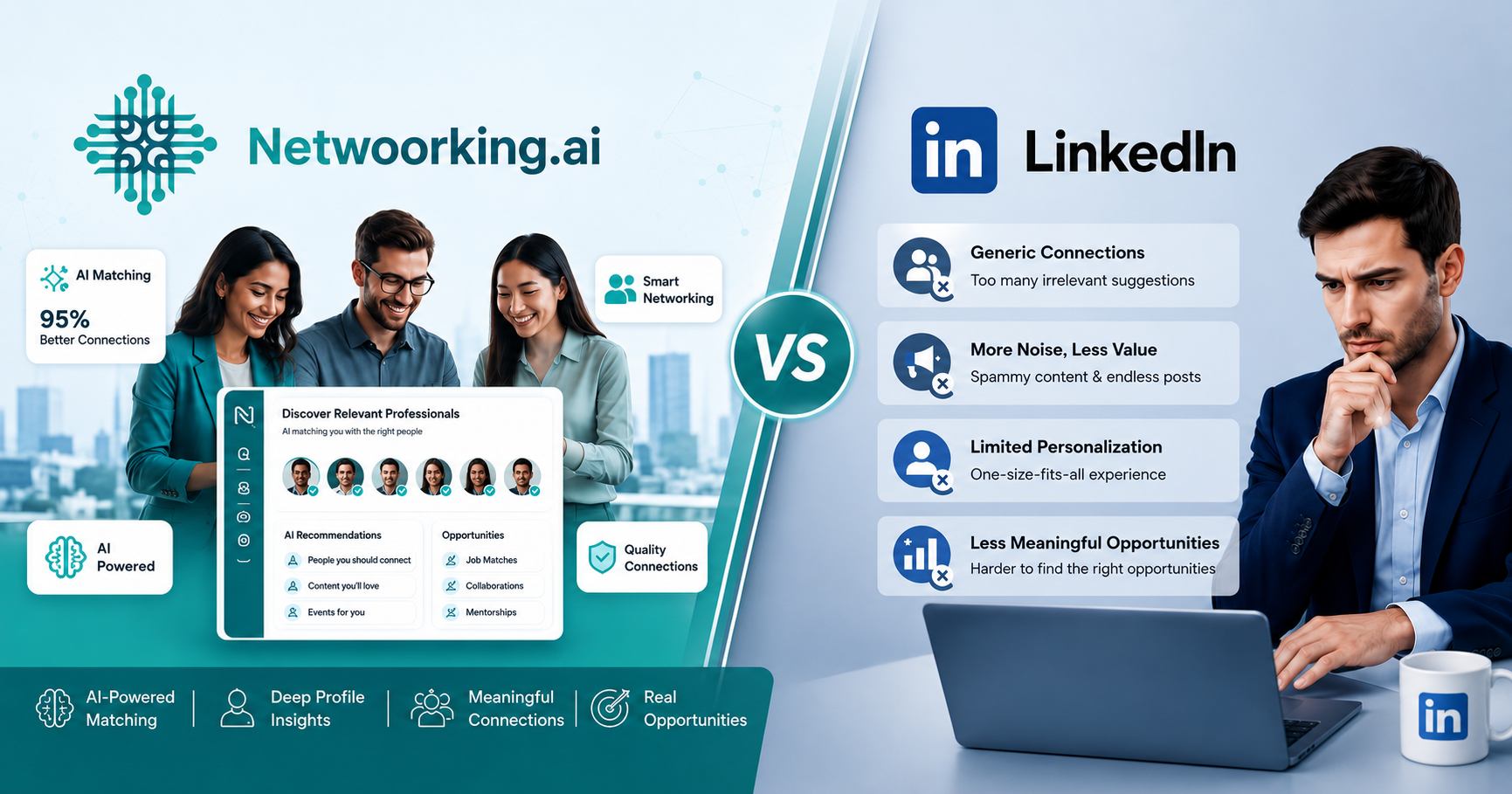
A massive list of surface-level followers looks impressive on a screen, but it rarely translates into real-world business outcomes. True professional leverage comes from clear, targeted relationships. Meeting three individuals who possess the exact resource, investment capability, or technical skill you need is infinitely more valuable than exchanging hollow pleasantries with fifty random people. This paradigm shift forms the foundation of modern AI-powered networking. When an individual uses a contemporary AI-powered Networking Platform like Netwoorking, the primary goal is not to expand an arbitrary follower count. The objective is to maximize networking efficiency by routing past the superficial noise and identifying the exact professionals who align with your immediate business path.
The Evolution of Conference Networking Technology
To truly understand how far professional matchmaking has come, it helps to map out the distinct eras of event technology. Conference organizers have long tried to solve the networking problem, but early iterations lacked the technical intelligence required to build deep context.
Era 1: The Directory and the Spreadsheet (The Manual Era)
In the early days, organizers printed physical booklets containing attendee names, company titles, and industries. If you wanted to find an investor or a technical co-founder, you had to manually flip through hundreds of pages. Later, this system moved to static digital formats like PDFs or basic online spreadsheets. The burden of research sat entirely on the attendee, resulting in low engagement and missed opportunities.
Era 2: Rule-Based Tagging (The Basic App Era)
As smartphones became universal, the first generation of event apps arrived. These platforms relied on explicit, rule-based tagging. During registration, you checked boxes for your industry (e.g., "Software Development") and your goals (e.g., "Looking for clients"). The app would then display a filtered list of everyone who checked similar boxes. While this was a step forward, it was highly rigid. If a user did not select the exact keyword phrase another user searched for, the system failed to connect them. It could not understand synonyms, context, or nuanced business goals.
Era 3: Semantic Vectors and Behavioral Intelligence (The Modern AI Era)
Modern conference networking technology relies on mathematical vectors and natural language understanding. Instead of matching users on rigid keyword tags, modern algorithms analyze entire profiles, conversational onboarding data, and real-time behavioral signals. This approach allows the system to recognize that a user who writes "I want to scale my software backend" matches perfectly with someone else who lists expertise in "Cloud architecture and infrastructure scaling." The two profiles do not need to share the exact same keywords because the system understands the semantic meaning of their statements.
How AI Matchmaking for Events Works Under the Hood
The term "AI" gets thrown around constantly, but how does an AI matchmaking for events framework actually make a recommendation? It does not rely on magic; it relies on clear engineering principles designed to parse human intent. Modern platforms use three distinct layers to generate high-quality recommendations for attendees.
1. Natural Language Onboarding and Goal Capture
Static registration forms with endless drop-down menus are largely obsolete. Modern platforms increasingly utilize conversational onboarding. When a user creates a profile on an AI-powered conference networking platform, they speak or write in plain, natural language. The AI reads this unstructured text and extracts two core components: Asks and Offers.
The Ask: What specific resource, knowledge, or partnership does the attendee need right now?
The Offer: What unique skill, industry experience, capital assets, or market access do they bring to the table?
By converting plain sentences into structured data points, the system builds an accurate map of attendee intent before anyone ever sets foot in the convention center.
2. Semantic Vector Embeddings
Once the platform captures user intent, it converts the profile into a high-dimensional mathematical model called a vector embedding. In simple terms, this process turns a person’s professional background, skills, and business goals into a coordinate point in a digital space. Profiles with highly aligned business interests sit physically close to each other inside this mathematical map. The system runs continuous algorithms to rank every attendee against every other attendee based on this conceptual proximity. This technique allows a conference matchmaking engine to surface relationships based on deep compatibility rather than surface-level criteria like matching job titles.
3. Behavioral and Real-Time Signal Adjustment
Static profiles only tell part of the story. A truly smart event networking platform monitors how users actively interact with the system before and during the event. The machine learning model adjusts its recommendations based on real-time actions, including:
Which sessions, keynotes, or panel discussions the attendee adds to their personal schedule.
Which types of profiles they click on, bookmark, or skip.
The acceptance and rejection rates of their initial meeting requests.
If an attendee starts exploring a new topic midway through a conference, the AI notices the behavioral shift and instantly updates their recommended connections to reflect that fresh interest.
Common Networking Mistakes Professionals Make
Even when equipped with top-tier technology, many professionals fall into habitual traps that severely limit their professional growth. Understanding these Networking Mistakes is essential if you want to make the most of an AI-driven environment.
The Shotgun Approach
The most common mistake is attempting to speak with everyone. Professionals who look at a conference as a numbers game tend to blast generic message templates to dozens of attendees inside an app. This approach dilutes your energy, annoys potential partners, and lowers your overall connection quality. High-volume, low-context outreach rarely yields meaningful results.
Passive Waiting
Many individuals download a networking app for events, fill out a bare-minimum profile, and then wait for other people to pitch them. AI can only match you based on the data you provide. If you leave your profile empty or skip the goal-capture questions, the algorithm lacks the necessary signals to connect you with top-tier partners.
Ignoring Pre-Event Intelligence
A massive portion of conference ROI is decided before the opening keynote ever begins. Waiting until you arrive on the exhibition floor to look for meetings is a massive strategic error. The highest-performing attendees use the event's digital matching tools days in advance to pre-schedule their high-priority conversations.
Over-Focusing on Pitching Instead of Partnering
Entering a conversation with the sole intent of selling a product or service creates immediate friction. True networking is about mutual exchange. When you focus entirely on your own goals without looking for ways to provide value to the other person, you block the development of long-term business relationships.
Key Benefits of a Modern Event Networking Platform
Implementing dedicated event matchmaking software for conferences provides massive advantages for attendees, corporate sponsors, and event organizers alike. Here is how smart technology directly upgrades the entire conference lifecycle.
Enhanced Event Personalization
No two attendees walk into a conference with the same exact set of needs. A venture capitalist looking for early-stage fintech startups requires a completely different event experience than a senior engineer looking for a new corporate role. AI enables deep event personalization. It acts as a digital concierge, filtering through thousands of attendees and curation spaces to highlight the exact individuals, roundtables, and exhibitors that match your professional path.
Traditional Vs. AI-Driven Networking
FeatureTraditional EventsAI PlatformsConnection MethodRandom chanceVector matchingPrimary Prep TimeOn-site in hallwaysPre-event setupPrimary MetricTotal cards swappedReply/Meet rateProfile BasisStatic job titlesDynamic goalsLongevityEnds at the venueMoves to the community
Unlocking Meaningful Connections
A Meaningful Connection is one where both parties experience an immediate click of mutual benefit. It could be a shared market problem, a complementary skillset, or a direct investment alignment. By showing users exactly why they matched with another person, such as a shared intent to expand into a specific geographic market, the technology breaks down structural barriers and sparks authentic dialogue instantly.
Automated Coordination and Scheduling
Finding a mutually open time slot in a chaotic conference environment can be an absolute headache. An advanced conference networking app eliminates this scheduling dance through deep networking automation. Once the system identifies a high-value match, attendees can view each other's open slots, book a dedicated meeting table on the venue floor, and sync the details directly to their native phone calendars with a single tap. This level of organization maximizes your time on-site, ensuring you never waste an open hour.
Lasting Post-Event Communities
Historically, when the venue lights turned off and attendees headed to the airport, the network built during the event immediately fractured. Attendees returned to their respective siloes, and the momentum vanished. Modern platforms change this dynamic by serving as a bridge between physical events and persistent professional ecosystems. When you use an ecosystem like Netwoorking.com, the matches you make at a physical summit carry over into a continuous, digital workspace. The platform retains a memory of who you met, allowing you to nurture those business relationships over months and years, long after the physical banners are taken down.
Driving Measurable Results: Event ROI and Analytics
For corporate teams and individual executives, every business trip must be justified by clear metrics. You cannot easily measure the value of a casual conversation over dinner, but you can absolutely measure the concrete outcomes driven by an AI conference networking workspace. Data collected from global conference deployments highlights a clear trend: when events swap out random networking directories for curated AI matchmaking, engagement metrics skyrocket.
Higher Reply Rates: Algorithmic introductions backed by a clear written explanation of why two people should meet see an average reply rate of 35% to 40% within 24 hours. In contrast, uncurated, cold blind-outreach inside legacy event apps typically lands in the single digits.
Widespread Adoption: According to major industry studies, over 95% of event professionals expect their organizations to scale up their use of AI-driven tools. Attendees no longer view smart matchmaking as a luxury; they treat it as an absolute baseline requirement for an event to be worth their time.
Pipeline Attribution: For event sponsors and B2B exhibitors, modern platforms allow them to track exactly how a physical interaction at a booth moves down a digital sales funnel. This structural link gives companies a clear, undeniable picture of their overall event ROI.
Step-by-Step: How to Build a Professional Network Using AI
Maximizing your professional growth in an AI-driven business ecosystem requires an intentional, step-by-step methodology. You cannot simply log in and expect the technology to do all the heavy lifting. You must provide the system with clean, high-signal data to achieve the best possible networking outcomes. Follow this structured framework to optimize your next major event appearance.
Step 1: Define Your Strategic Business Intent
Before opening an app, sit down and clarify your immediate operational goals. Are you looking to raise a seed round of capital? Are you searching for a reliable localized supply partner? Are you trying to find beta testers for a new B2B SaaS tool? Having crystal-clear goals prevents you from falling back into the trap of aimless mingling.
Step 2: Build a High-Signal Professional Profile
When you register for an AI-powered platform, treat the onboarding process with deep focus. Avoid vague, generic summaries like "Experienced consultant with a history of driving growth." Instead, use highly specific details, absolute numbers, and definitive goals. Write sentences that a language model can easily parse: "I am an enterprise SEO strategist managing content architecture for high-growth startups, currently looking to partner with international web development agencies specializing in fast headless CMS deployments." This granular detail gives the vector engine exactly what it needs to pinpoint perfect matches.
Step 3: Audit Your Smart Recommendations Early
Log into the platform at least one to two weeks before the live event kicks off. The AI will immediately present a curated shortlist of your top potential connections. Spend twenty minutes reviewing these recommendations. If the system serves up a match that hits the bullseye, accept it and request a short meeting. If a match feels off-target, flag it as irrelevant. This action signals the machine learning model to refine its parameters, ensuring your match quality improves every single day leading up to the conference.
Step 4: Secure Pre-Scheduled Meeting Slots
Do not leave your on-site schedule open to chance. Use the app's calendar integration to lock in your highest-priority 1:1 meetings well before arrival. Aim to fill your mornings with targeted, structured discussions at designated meeting zones, leaving your afternoons open for spontaneous follow-ups, workshop sessions, and keynotes.
Step 5: Execute and Move the Connection to a Continuous Space
When you sit down for your scheduled meeting, skip the generic icebreakers. Because the platform has already established the mutual context for why you are meeting, you can dive straight into high-value collaboration. Once the conversation wraps up, use the platform's instant digital scanning or resource-sharing features to anchor the relationship. This ensures that the moment the physical event ends, the connection naturally transitions into a persistent digital community hub where you can continue collaborating seamlessly.
The Broader Impact: Transforming the Startup Ecosystem
The benefits of AI event matchmaking extend far beyond individual career advancement. On a macro level, this technology is fundamentally democratizing how startup ecosystems, venture capital, and cross-border business relationships operate. In the old, informal networking model, access to high-value capital and strategic partnerships depended heavily on existing social privilege. If you did not attend a specific elite university, live in a major tech hub city, or possess a warm personal introduction to a venture capital firm, breaking into those circles was incredibly difficult. Hallway networking at major tech summits frequently turned into an exclusive game where insiders stuck together, and independent founders struggled to get noticed. Smart matchmaking algorithms completely rewrite this dynamic. An AI does not care about your social circles or your pedigree; it looks purely at the raw data of your Asks and Offers.
[ Founder Inputs Plain Text Data ] [ AI Extracts Asks & Offers ] [ High-Dimensional Vector Match ] ── (Bypasses Pedigree / Elite Accents) [ Direct 1:1 Strategic Match ]
If a brilliant developer from a developing market stands out with a unique technical solution that solves a precise infrastructure problem for an enterprise buyer, the system will highlight that compatibility instantly. It flattens structural access barriers, allowing the absolute best ideas, talents, and capital resources to find each other purely based on mutual utility and strategic merit.
Conclusion
The era of navigating business events via random guesswork is coming to an end. Professional networking is no longer about surviving a crowded room of strangers or collecting an endless stream of superficial social media followers. It is an intentional, data-driven discipline focused on maximizing the value of human interaction. Platforms like Netwoorking AI are proving that when you combine human intent with advanced AI matchmaking, you eliminate the friction, anxiety, and inefficiency of traditional networking. By transforming random crowds into curated networks, smart technology helps founders find their ideal investors, companies locate their perfect strategic partners, and professionals secure genuine avenues for long-term professional growth.
The next time you register for a major industry conference, do not just look at the list of keynote speakers or the venue layout. Look closely at the technology driving the attendee experience. Take the time to build a clear, data-driven profile, embrace the power of smart recommendations, and step into an environment where every single handshake is backed by data. Your professional network is your ultimate asset; it is time to build it with absolute intent.
Get the next article in your inbox
Stay updated with practical insights, product updates, and networking tips — delivered straight to your inbox.