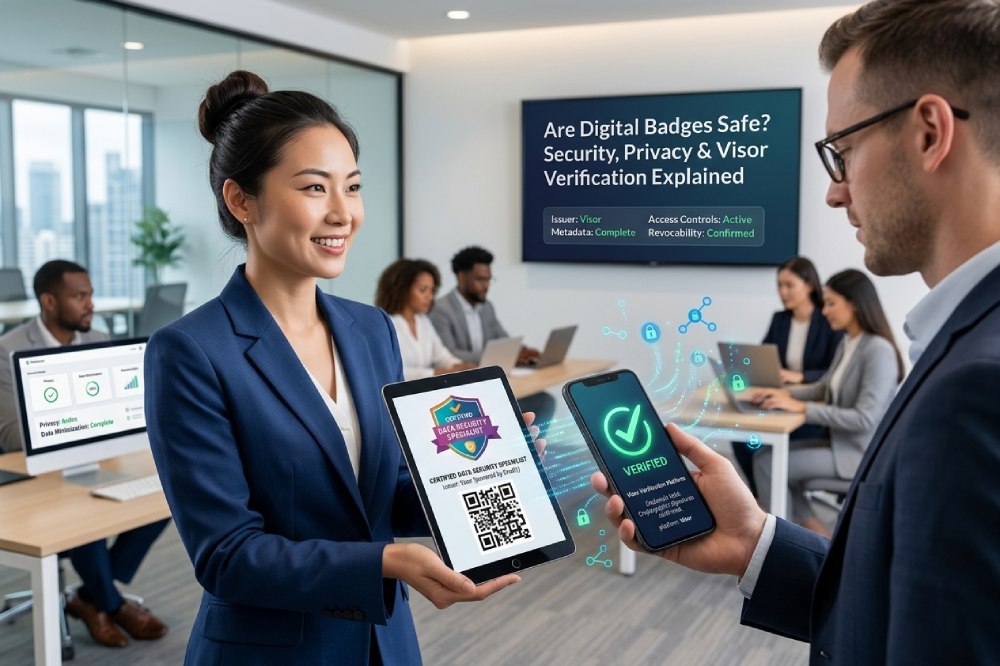
Digital badges are increasingly used by universities, professional organizations, employers, training providers, and event organizers to recognize skills, certifications, and achievements. But as more credentials move online, an important question comes up: Are digital badges safe?
Generally, digital badges can be secure and highly verifiable when they are issued through a reputable platform and built on recognized standards. Modern badge standards can use cryptographic proofs, structured metadata, access controls, and verification systems to make credentials difficult to falsify.
However, security is not automatic. The safety of a digital badge depends on how it is created, what information it contains, where it is stored, and how it is shared.
Digital credentials are also increasingly connected with smart badge technology, particularly in environments where organizations want to combine digital identity, verification, access management, or event participation. While a smart badge may include technology-enabled features, it should not automatically be treated as the same thing as a verifiable achievement credential.
What Makes a Digital Badge Secure?
A digital badge is more than a simple image. Standards such as Open Badges allow credentials to contain structured information about the achievement, issuer, recipient, criteria, and supporting evidence. Open Badges 3.0 also uses digitally signed Verifiable Credentials, helping a verifier establish that the credential came from the claimed issuer and has not been improperly altered.
Several security features can contribute to a safer digital badge:
Digital signatures: Cryptographic proofs can help verify that a credential was issued by the stated organization.
Structured metadata: Information about the achievement and issuing organization provides context for verification.
Issuer verification: A verifier can check the credential against information associated with its issuer.
Tamper evidence: Verifiable Credentials are designed to make unauthorized changes detectable.
Secure APIs: Modern credential systems can use authentication and authorization technologies such as OAuth 2.0 to control how credentials are issued, transferred, and verified.
Access controls: Platforms can restrict who can issue, manage, view, or revoke credentials.
This means copying the appearance of a badge does not necessarily reproduce the underlying verified credential.
For organizations exploring electronic badges for conferences, professional training, education, or employee recognition, the same principle applies: the technology behind the credential matters more than the visual design.
Can Someone Fake or Copy a Digital Badge?
A person can copy a badge image just as they could scan or reproduce a paper certificate. The important difference is that a properly implemented digital credential can be checked against its underlying verification data.
For example, a verifier may click a badge or open its credential record to confirm:
Who issued it
Who earned it
What achievement it represents
What criteria were required
When it was issued
Whether supporting evidence is available
Whether the credential is still valid
Credly, for example, explains that its badges connect the visual badge to verified data hosted on its platform, allowing viewers to check the details behind the credential.
Therefore, the image itself is not the main security feature. The verification system and credential data behind it are what provide trust.
This distinction is also important when comparing digital credentials with digital name badges. A digital name badge may identify a person or display information, while a verifiable achievement badge provides evidence about a particular skill, qualification, or accomplishment.
Are Digital Badges Safe for Personal Information?
This is where privacy requires more attention.
A digital badge can contain personally identifiable information (PII), depending on how the issuer designs it. 1EdTech notes that badge metadata may include information such as a learner's name, email address, telephone number, and evidence associated with an achievement.
The safest approach is to follow the principle of data minimization: only include information that is genuinely necessary to establish the achievement.
For example, a badge generally does not need to contain:
Government identification numbers
Medical information
Sensitive personal information
Unnecessary contact details
Individual test scores or grades
1EdTech specifically advises issuers to avoid putting sensitive information such as Social Security numbers, health information, or disability information into Open Badges.
This is important because digital badges are designed to be shareable. Information embedded in a credential may potentially travel with it when the badge is shared.
Organizations using smart badges for schools or educational credentialing systems should therefore distinguish between information needed to verify an achievement and information that should remain private within institutional systems.
Can Digital Badges Be Private?
Yes, depending on the platform and credential system.
Some platforms provide controls that allow earners to decide whether their badges or profiles are publicly visible. For example, Credly allows users to make individual badges or their entire profile public or private.
However, privacy controls vary between platforms. Organizations should therefore examine the platform's privacy settings and policies before selecting a digital badging solution.
Issuers should also clearly communicate:
What information is collected
What information appears in the badge
Who can view the credential
Whether the credential can be made private
How long credential data is retained
How evidence and supporting documents are protected
A secure smart ID badge or digital credential system should similarly apply appropriate access controls so that identification information is not unnecessarily exposed.
How Does Visitor Verification Work?
Visitor verification is particularly useful when a digital badge is displayed on a website, professional profile, email signature, or social media account.
A visitor does not simply have to trust the badge image. Instead, they can follow the badge's verification link or credential record.
The verification process typically works like this:
1. A credential is issued
An organization awards a badge after the recipient meets defined requirements.
2. Credential information is recorded
The badge contains structured information describing the achievement, issuer, recipient, and criteria.
3. The badge is shared
The recipient can place the badge on a website, professional profile, social network, or email.
4. A visitor clicks the badge
The visitor is directed to a credential page or verification mechanism.
5. The credential is checked
The visitor can review the issuing organization and achievement details and, where supported, verify the credential's authenticity.
This creates an important distinction between seeing a badge and verifying a badge.
In event environments, an event badge system may use similar digital verification principles for registration and identity management. However, an event identification badge is primarily designed to manage attendance or access, while an achievement credential is designed to communicate verified skills or accomplishments.
What Should Visitors Check Before Trusting a Badge?
A digital badge should not automatically be considered legitimate simply because it looks professional.
Visitors should check:
Issuer: Is the badge actually associated with a legitimate organization?
Achievement: Does the credential clearly explain what was earned?
Criteria: Does it describe how the recipient qualified?
Verification: Is there a functioning verification method?
Evidence: Is supporting evidence available where appropriate?
Dates: Was the credential recently issued, and does it expire?
Destination: Does the verification link lead to a legitimate credential platform or issuer?
Open Badges are specifically designed to provide contextual information about who issued a credential and what the recipient achieved, making this type of verification possible.
For interactive badge systems, users should also understand what happens when they click or scan the badge. A badge may direct someone to a public credential page, verification service, registration record, or another online destination. The destination should be checked before users enter additional information.
Are Digital Badges More Secure Than Paper Certificates?
They can provide advantages that paper certificates do not, but security depends on implementation.
A paper certificate can be photocopied or edited. A digital badge built using a recognized credential standard can contain machine-readable metadata and cryptographic proof that allows its authenticity to be checked.
Open Badges 3.0, for example, uses Verifiable Credentials and digital signatures to strengthen credential authenticity and integrity.
However, a basic badge that is only a JPEG or PNG image without verifiable metadata does not offer the same level of assurance. Credly notes that badges following Open Badges standards contain information that supports verification, while simple images may lack the data needed to confirm authenticity.
This is why an event smart badge or digital credential should not be evaluated solely by its appearance. The underlying data, verification mechanism, issuer controls, and privacy protections are more important.
Smart Badges, Event Badges, and Digital Credentials
The term “smart badge” can refer to several different technologies, so organizations should define what the badge is designed to do.
A smart badge may be a technology-enabled physical or digital badge used for identity, access, networking, attendance, or information display. Depending on the system, it may use QR codes, NFC, Bluetooth, digital displays, or connected software.
By contrast, a digital achievement badge primarily communicates a verified skill, competency, qualification, or accomplishment.
For example, smart badges for conferences may help organizers manage registration, networking, attendance, or access. Smart conference badges can also be connected to event platforms that provide information about attendees or sessions.
Similarly, smart event badges may be used to support check-in and event participation, while attendance badges can recognize participation in a particular event, course, or activity.
These systems can overlap, but the security requirements are different. An achievement credential needs trustworthy evidence and verification, while an event or identity badge may require stronger controls around access, identity, location, or temporary permissions.
How Organizations Can Make Digital Badges Safer
Organizations issuing digital badges should consider security and privacy from the beginning.
Best practices include:
Use established credential standards such as Open Badges.
Choose a platform with appropriate security and privacy controls.
Minimize personally identifiable information.
Protect evidence containing sensitive information.
Use authentication and authorization for credential management.
Give earners appropriate visibility and sharing controls.
Establish clear retention and privacy policies.
Regularly review platform security and data-handling practices.
Provide a reliable verification mechanism.
Establish procedures for credential expiration and revocation.
Organizations that use a programmable badge system should also ensure that changes to badge data, access permissions, or credential status are properly controlled and logged.
The goal should not simply be to make a badge difficult to copy. It should be to create a credential system where the underlying achievement can be reliably authenticated without unnecessarily exposing personal information.
1EdTech emphasizes that secure credentialing is a shared responsibility involving standards, implementation, institutional policies, supplier practices, configuration, and ongoing risk management.
Security Questions to Ask Before Choosing a Badge Platform
Before adopting a digital badging platform, organizations should evaluate more than its design tools or sharing features.
Important questions include:
Does the Platform Support Recognized Standards?
Standards such as Open Badges and Verifiable Credentials can provide a structured foundation for issuing and verifying credentials.
How Is Credential Data Protected?
Organizations should understand how credential information and supporting evidence are stored, transmitted, and accessed.
Can Credentials Be Revoked?
If a credential becomes invalid, there should be a clear mechanism for updating its status or revoking it.
What Privacy Controls Are Available?
Issuers should be able to determine what information is public, what remains private, and who can access supporting evidence.
How Does Verification Work?
A third party should have a straightforward way to confirm the issuer, achievement, criteria, and credential status.
Does the Platform Integrate Securely?
Organizations may connect credential platforms with learning management systems, HR systems, event software, or other applications. Secure authentication and authorization should be considered for every integration.
Conclusion
So, are digital badges safe? They can be, provided they are issued, stored, shared, and verified through properly designed systems.
The strongest digital badges are not merely attractive graphics. They connect an achievement to structured credential data, a recognized issuer, defined earning criteria, and a reliable verification mechanism. Modern standards such as Open Badges 3.0 add cryptographic proofs and Verifiable Credential capabilities that strengthen trust and portability.
Privacy still matters. Organizations should collect only the information necessary for the credential, protect sensitive evidence, and give recipients meaningful control over how their achievements are shared.
Whether an organization is issuing achievement credentials, managing event smart badges, or implementing a broader identity and verification system, the underlying principle remains the same: security should be built into the credential lifecycle rather than added after the badge has already been issued.
Get the next article in your inbox
Stay updated with practical insights, product updates, and networking tips — delivered straight to your inbox.