
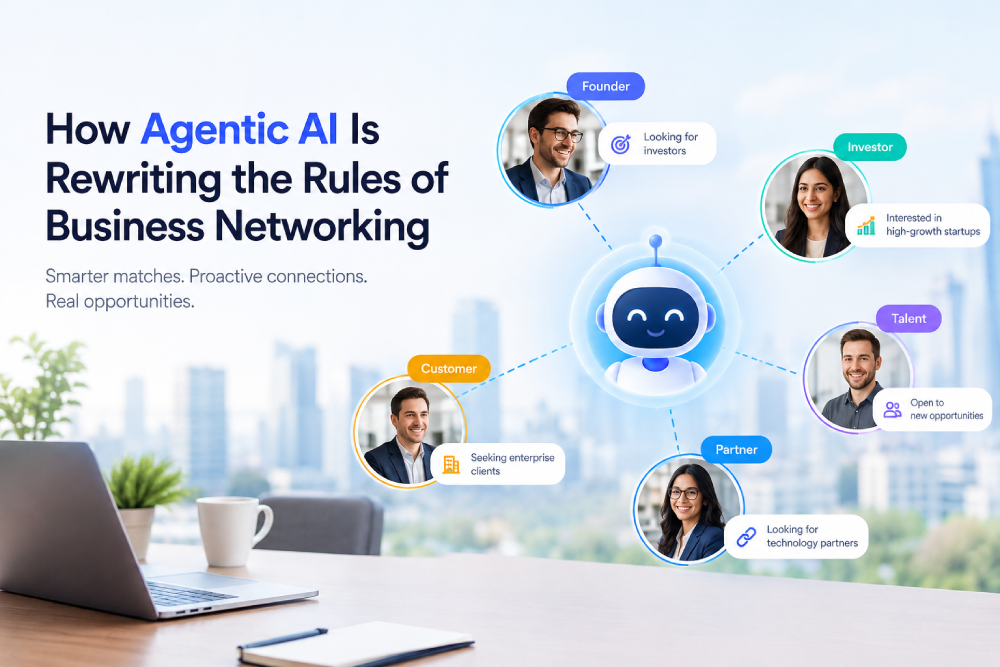
Business networking has traditionally depended on human effort: attending events, exchanging contacts, browsing profiles, sending messages, and following up. The problem is that valuable connections are often hidden among hundreds of irrelevant ones. Agentic AI is changing that model.
Unlike traditional AI that primarily generates answers, agentic systems can reason through objectives, perform multi-step tasks, trigger workflows, and act with a degree of autonomy. McKinsey describes agentic AI as a shift from AI that simply responds to systems that can take action and complete complex processes.
That capability has significant implications for business networking. Instead of expecting professionals to find the right people themselves, AI agents can increasingly help identify opportunities, evaluate potential matches, and facilitate introductions.
From Searching for People to Finding the Right People
Traditional professional networking is largely profile-driven. You search by job title, company, industry, location, or skills and then decide whom to contact. But a job title does not tell you what someone wants right now. A founder might be a CEO, but today they may be looking for:
A technical co-founder.
Their first enterprise customer.
A strategic investor.
A mentor with industry experience.
A technology partner.
Agentic networking changes the starting point from “Who is this person?” to “What does this person need?”
Emerging AI networking platforms are already experimenting with this intent-first model, matching people according to goals and explaining why a connection makes sense.
How Agentic AI Changes Networking
The biggest difference is that an AI agent can operate continuously rather than waiting for a professional to manually search.
A networking agent can potentially monitor relevant signals, understand a user's objectives, identify compatible people, evaluate mutual fit, and prepare an introduction. Four changes are particularly important:
Discovery becomes proactive: Instead of searching directories, users can receive relevant opportunities automatically.
Matching becomes contextual: AI can consider goals, skills, experience, industry, and current intent rather than relying only on profile keywords.
Introductions become more relevant: The system can explain why two people should meet before either person invests time in a conversation.
Networking becomes continuous: An agent can keep looking for opportunities even when the user is not actively browsing.
This moves AI networking beyond recommendation lists toward a more active relationship-building system.
Intent Becomes the New Networking Currency
One of the biggest weaknesses of conventional networking platforms is that profiles are mostly static. Your profile may say you are a marketing director. It does not necessarily say that you are currently searching for a SaaS partnership or looking for a startup to advise.
Intent provides that missing layer.
New AI networking products are already focusing on statements such as “I need a co-founder,” “I am looking for enterprise clients,” or “I want to find a mentor.” These systems then attempt to identify complementary intent rather than simply similar profiles.
That distinction is powerful because the best business relationship is not always between two similar people. A founder looking for investment needs an investor. A company hiring needs talent. A SaaS provider needs customers. A startup entering a new market may need a local partner. AI can recognize these complementary needs much faster than manual browsing.
AI Agents Can Become Personal Networking Representatives
The next stage of AI-powered networking is not simply recommending people. It is allowing an agent to perform parts of the networking process on a professional's behalf.
Imagine telling your agent:
“I am looking for three potential technology partners in Europe that serve mid-market businesses and are open to partnerships.”
Instead of giving you hundreds of search results, the agent could identify potential matches, assess their relevance, summarize the reasons for each match, and prepare possible introductions.
Some emerging platforms are already positioning AI agents as representatives that continuously scout for customers, partnerships, jobs, funding, and other opportunities. Human approval can remain important, particularly when an introduction involves reputation, privacy, or commercial commitments.
From Networking Events to Intelligent Opportunity Networks
Events have traditionally been one of the strongest environments for AI matchmaking because hundreds or thousands of people may be present, but each attendee has different goals.
An attendee might want investors while another wants customers. A third wants employees, while another is searching for suppliers. AI can process these different objectives at scale. Modern networking agents are being designed to capture attendee goals, identify relevant matches, explain the reasoning behind those matches, and even help initiate conversations. This could transform the traditional event experience:
Old model: Attend → browse → guess → message → wait.
Agentic model: State your goal → AI identifies mutual opportunities → review → approve → connect.
The Rise of Autonomous Business Networking
The long-term opportunity for business networking AI goes beyond individual introductions. Imagine networks where AI agents can communicate with other agents, identify complementary business needs, qualify opportunities, and bring only high-value possibilities to human users.
Emerging projects are already exploring agent-to-agent networking and autonomous intent matching. This could create a new layer of AI business connections where opportunity discovery happens continuously in the background.
What Businesses Need to Consider?
Agentic networking will not succeed simply because an AI can send messages. Trust, privacy, transparency, accuracy, and human control will determine whether professionals actually adopt these systems.Businesses should prioritize:
Clear consent before automated outreach.
Transparent explanations for why matches are recommended.
Human approval for important introductions.
Strong data protection and access controls.
Systems that measure relationship quality rather than message volume.
This is especially important because autonomous AI introduces new governance and security challenges. Current research and industry discussions emphasize that organizations need appropriate infrastructure, controls, and governance as AI becomes more autonomous.
Conclusion
Agentic AI is rewriting networking by shifting the focus from profiles, contacts, and endless searching toward intent, context, and action.
The future of intelligent networking may not be about having the largest contact list. It may be about having an AI agent that understands what you are trying to accomplish and continuously helps you find the people who can make it happen. Networking is becoming less about who you know and more about who your agent can intelligently help you meet.
FAQs
1. What is agentic AI in business networking?
It is AI that can understand networking goals, identify relevant opportunities, perform multi-step discovery, and assist with introductions or follow-ups.
2. How is agentic AI different from traditional networking tools?
Traditional tools usually require users to search profiles manually. Agentic systems can proactively identify relevant connections based on goals and intent.
3. Can AI agents replace human networking?
No. AI can handle discovery and repetitive tasks, but humans remain essential for trust, relationship building, judgment, and important business decisions.
4. What is the future of AI-powered networking?
The direction is toward continuously active agents that identify mutual opportunities, qualify potential connections, and bring high-value introductions to humans for approval.
Get the next article in your inbox
Stay updated with practical insights, product updates, and networking tips — delivered straight to your inbox.
