
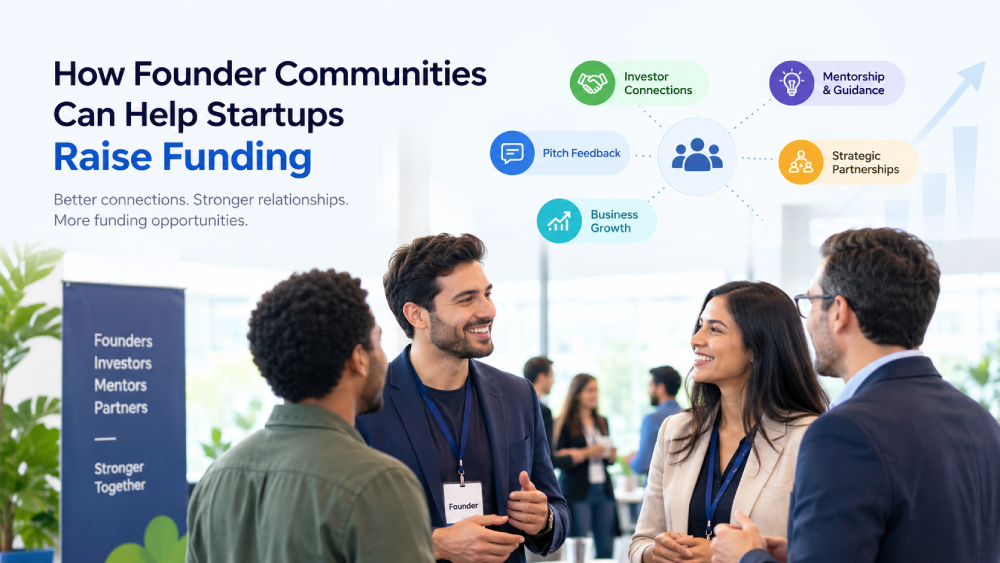
Raising capital is one of the biggest challenges founders face. A strong product, clear business model, and ambitious vision are important, but they do not automatically attract investors. Fundraising is also about relationships, credibility, timing, and access to the right people. This is where joining the right founder community can make a significant difference.
A well-connected startup community gives entrepreneurs opportunities to meet experienced founders, investors, advisors, mentors, and potential partners. Instead of building every relationship from scratch, founders can enter an environment where valuable connections already exist. The right community can therefore shorten the path between having a fundraising goal and finding the people who can help achieve it.
Why Founder Communities Matter for Fundraising?
Fundraising rarely happens through a single pitch meeting. Investors often discover startups through referrals, founder networks, accelerator programs, industry events, and trusted introductions. Being part of an active entrepreneur community increases the number of opportunities a founder has to build these relationships.
A strong startup networking environment can expose founders to people who have already raised funding and understand the process. These connections can help founders identify suitable investors, improve their pitch, understand valuation expectations, and avoid common fundraising mistakes. The biggest advantages include:
Access to experienced entrepreneurs who understand fundraising.
Opportunities to meet angel investors and venture capital professionals.
Feedback on pitch decks and fundraising strategies.
Introductions to potential customers and strategic partners.
Greater visibility within the startup ecosystem.
Opportunities to learn from other founders' successes and failures.
Access to Investors Through Warm Introductions
One of the biggest advantages of a quality founder network is access. Investors are often overwhelmed by pitches, emails, and applications. A warm introduction from someone they trust can help a startup get noticed.
Founder communities can facilitate these introductions naturally. A fellow entrepreneur may know an angel investor looking for opportunities in a particular sector. An advisor may have connections with a venture capital firm. Another founder may introduce a startup to an investor after hearing its pitch during a community event.
This is why networking for founders should not be treated as simply collecting contacts. The objective is to develop meaningful relationships that can eventually lead to introductions, partnerships, advice, and funding opportunities.
Learning From Founders Who Have Already Raised
Fundraising becomes easier when founders understand what successful fundraising actually looks like.
Within an active startup founders community, entrepreneurs can learn directly from people who have completed funding rounds. They can ask practical questions about investor outreach, pitch decks, due diligence, term sheets, valuation, equity, and negotiation. Experienced founders can help with:
Reviewing and improving investor pitch decks.
Explaining common fundraising terminology.
Identifying realistic funding targets.
Preparing for investor questions.
Understanding due diligence requirements.
Sharing lessons from previous funding rounds.
This peer-to-peer learning is valuable because experienced founders can share lessons based on real situations rather than generic fundraising advice.
Building Credibility Before Asking for Money
A founder should ideally build relationships before starting a fundraising campaign. Participating consistently in a business networking community can help establish credibility over time. Founders can demonstrate expertise by answering questions, sharing industry insights, attending events, supporting other entrepreneurs, and discussing their progress.
This creates a stronger personal and professional reputation. When fundraising eventually begins, people in the community may already understand the founder, their expertise, and their company's direction. Founders can build credibility by:
Sharing useful industry knowledge.
Helping other entrepreneurs solve problems.
Participating in community discussions.
Attending relevant events consistently.
Offering introductions when appropriate.
Demonstrating progress and milestones.
Trust is especially important for early-stage startups because investors are often evaluating the founder as much as the business.
Getting Better Fundraising Feedback
A founder can spend weeks preparing a pitch deck and still overlook obvious problems. A community provides access to different perspectives before the deck reaches investors.
A useful online founder community may include entrepreneurs from different industries, stages, and backgrounds. Their feedback can help founders refine their positioning, clarify their value proposition, improve financial assumptions, and prepare stronger answers to investor questions.
| Fundraising Challenge | How a Founder Community Can Help |
|---|---|
| Weak pitch deck | Peer reviews and founder feedback |
| Limited investor access | Warm introductions |
| Unclear valuation | Advice from experienced founders |
| Poor investor targeting | Connections with relevant investors |
| Difficult investor questions | Pitch practice and mock sessions |
| Limited market knowledge | Industry discussions and expert advice |
| Lack of credibility | Consistent community participation |
Some communities also organize pitch sessions, demo days, investor events, and workshops. These activities give founders opportunities to practice communicating their business clearly and confidently.
Finding the Right Investors
Fundraising is not simply about finding someone willing to invest. The right investor should understand the market, believe in the company's direction, and potentially provide useful expertise or connections.
An effective startup networking platform can help founders discover investors based on industry, geography, funding stage, interests, and expertise. This makes outreach more targeted.
For example, a health-tech startup may benefit more from an investor with healthcare experience than from an investor who simply has available capital. Similarly, a B2B SaaS founder may gain significant value from an investor who understands enterprise sales and technology markets. Founders should evaluate investors based on:
Industry expertise.
Previous startup investments.
Typical investment stage.
Geographic focus.
Available funding range.
Strategic connections.
Experience supporting founders.
Better investor matching can make fundraising more efficient while increasing the potential strategic value of the investment.
Turning Community Relationships Into Long-Term Growth
The benefits of a founder networking platform extend beyond one funding round. A relationship developed through a founder community can eventually lead to customers, employees, advisors, strategic partners, co-founders, media opportunities, and future investors. Someone who cannot invest today may introduce the founder to another investor tomorrow.
Founders should focus on building genuine relationships rather than immediately asking every new contact for funding. Strong communities are based on mutual values. Effective community participation includes:
Helping other founders before asking for help.
Sharing useful resources and opportunities.
Making relevant introductions.
Celebrating other members' achievements.
Providing constructive feedback.
Staying connected after fundraising ends.
This approach turns networking into a long-term business asset rather than a temporary fundraising tactic.
How to Choose the Right Founder Community
Not every community will be useful for every startup. Before joining, founders should consider the quality of members, relevance of the industry, activity level, investor access, mentorship opportunities, and overall culture.
Look for communities where members actively interact rather than simply joining and disappearing. A smaller network with relevant founders and investors can sometimes be more valuable than a large platform with thousands of inactive members. Consider these factors before joining:
Member quality: Are experienced founders and professionals participating?
Investor access: Does the community provide genuine investor connections?
Industry relevance: Are members working in industries related to your startup?
Activity: Are discussions, events, and collaborations happening regularly?
Mentorship: Can you learn from people with relevant experience?
Matching: Does the platform help you discover relevant people efficiently?
Founders should also consider whether the community supports their current stage. A pre-seed startup may need mentorship and angel introductions, while a growth-stage company may benefit more from venture capital relationships, strategic partnerships, and international networks.
Conclusion
The right founder community can significantly accelerate startup fundraising by improving access, credibility, knowledge, investor relationships, and strategic opportunities. Instead of approaching fundraising as a series of cold pitches, founders can build relationships within a network where trust develops naturally.
For entrepreneurs, the most valuable community is not necessarily the largest one. It is the community that connects them with the right people at the right stage and creates meaningful opportunities to learn, collaborate, and grow.
Fundraising ultimately depends on the strength of the business, but the right network can help ensure that the right investors actually discover it.
FAQs
1. Can founder communities help with fundraising?
Yes. They provide investor connections, advice, referrals, and pitch feedback.
2. Are founder communities useful for new startups?
Yes. They help founders build networks, gain mentorship, and find early investors.
3. How can founders meet investors?
Through community events, warm introductions, networking, and investor-focused sessions.
4. When should founders join a community?
Before fundraising. Building relationships early creates trust and stronger investor connections.
Get the next article in your inbox
Stay updated with practical insights, product updates, and networking tips — delivered straight to your inbox.
