

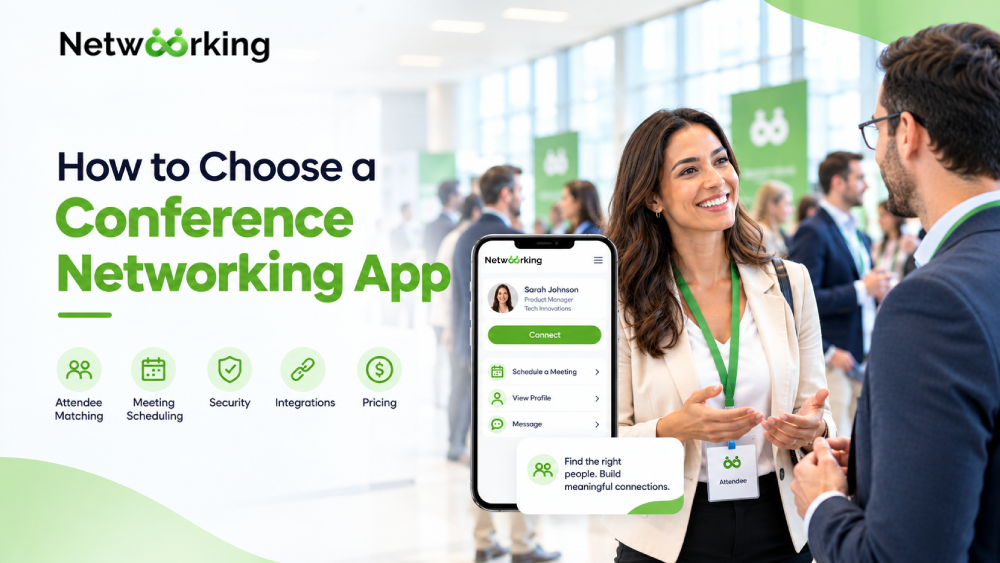
Conferences bring together professionals, entrepreneurs, investors, and industry experts, but finding the right people in a crowded event can be challenging. Attendees often spend valuable time browsing schedules, exchanging business cards, and trying to start conversations without knowing whether those connections will be useful.
A conference networking app can simplify this process by helping participants discover relevant attendees, arrange meetings, and maintain professional relationships. However, not every app offers the same features, so choosing one that matches your event goals is essential.
How to Choose a Conference Networking App?
Here's what to consider before selecting a solution for your next conference.
Identify Your Networking Goals
Start by defining what you want the app to accomplish. Are you helping attendees meet potential clients, connecting startup founders with investors, or encouraging professionals to exchange industry knowledge?
Your objectives will determine which features matter most. For example, an event focused on business partnerships may need advanced attendee matching and meeting scheduling, while an educational conference may prioritize discussion groups and speaker interactions.
Clear goals also make it easier to evaluate whether a conference networking app will deliver meaningful results rather than simply provide another communication channel.
Look for Smart Attendee Matching
One of the most valuable features is the ability to recommend relevant people based on professional interests, industries, job titles, or networking objectives.
Instead of scrolling through hundreds of profiles, attendees can discover contacts who share similar goals or complementary expertise.
Look for platforms that let users customize their interests and explain why particular matches are recommended. Human-reviewed recommendations or transparent matching criteria can also help participants understand their suggestions.
These capabilities make conference networking tools more useful for creating purposeful introductions and reducing the time spent searching for relevant contacts.
Evaluate Scheduling and Messaging Features
An effective app should make it easy to move from discovering a contact to arranging a conversation. Useful features include:
In-app messaging before and during the event.
Calendar integration and meeting reminders.
Availability-based scheduling.
Meeting locations or virtual meeting links.
Notifications about accepted invitations and schedule changes.
A well-designed networking event app should keep these actions straightforward. If attendees need several complicated steps to schedule a meeting, they may abandon the process.
Check whether the app supports both spontaneous conversations and prearranged meetings.
Check Integration With Your Event Platform
Many organizers already use registration systems, ticketing tools, event websites, or customer relationship management software. Your chosen app should work with these systems wherever possible.
An event networking platform with reliable integrations can reduce duplicate data entry, simplify attendee onboarding, and keep event information consistent.
Before committing, ask about registration imports, single sign-on, calendar integrations, and available APIs. Confirm whether these integrations are included in the price or require additional development.
Smooth integration can make the experience easier for both event organizers and participants.
Prioritize Ease of Use and Mobile Experience
Attendees need to access schedules, profiles, messages, and meeting details while moving between sessions. A confusing interface can discourage people from using the app.
Choose a solution with clear navigation, fast loading, accessible design, and a straightforward registration process. Test it on different screen sizes and check whether users can quickly update profiles or accept meeting requests.
A strong conference networking software solution should also offer clear instructions for first-time users. Consider running a small pilot before the event to identify usability problems.
Review Privacy and Security
Networking apps may collect names, job titles, contact details, professional interests, and meeting activity. Organizers should understand how this information is stored, shared, and protected.
Check for appropriate access controls, encryption, privacy settings, and clear data-retention policies. Attendees should be able to control which profile details are visible and whether other participants can contact them.
For international events, review applicable privacy requirements, including relevant data-protection laws. Make sure the provider explains how attendee information is handled.
Compare Pricing and Event Analytics
Pricing may depend on attendee numbers, event duration, available features, integrations, or support requirements. Compare the total cost rather than focusing only on the advertised subscription price.
Ask whether the provider charges extra for advanced matching, branded interfaces, analytics, or customer support.
Useful reporting may include profile completion, meeting requests, accepted invitations, and attendee engagement. These measurements help organizers understand participation and assess conference networking ROI.
Avoid relying solely on downloads or registrations to measure success. Meaningful interactions and relevant follow-up meetings provide better insight into networking outcomes.
Test Support and Scalability
Before choosing a provider, ask how the platform handles technical issues during live events. Reliable support matters when attendees cannot access profiles, receive meeting notifications, or join scheduled sessions.
Check available support hours, onboarding assistance, documentation, and emergency contact procedures.
If your organization plans to host larger events in the future, confirm that the solution can accommodate increased attendance, multiple sessions, and different event formats without sacrificing performance.
Conclusion
Choosing the right conference networking app requires more than comparing feature lists. Consider your event objectives, attendee matching, scheduling, integrations, usability, privacy, pricing, and technical support.
Request a demonstration, test the user experience, and gather feedback from a small group before making your final decision. The right solution should make professional connections easier, encourage meaningful conversations, and help attendees maintain relationships long after the conference ends.
Frequently Asked Questions
1. What features should a conference networking app include?
Look for attendee matching, messaging, meeting scheduling, profile management, privacy controls, and useful engagement analytics.
2. Are conference networking apps suitable for small events?
Yes. They can help smaller events organize introductions and meetings, although a simple solution may be sufficient.
3. How much does a conference networking app cost?
Pricing varies by provider, attendee numbers, features, and event duration. Request a quote based on your specific requirements.
4. How can organizers measure an app's effectiveness?
Track meaningful connections, accepted meeting requests, attendee engagement, follow-up meetings, and feedback after the event.
Get the next article in your inbox
Stay updated with practical insights, product updates, and networking tips — delivered straight to your inbox.
