
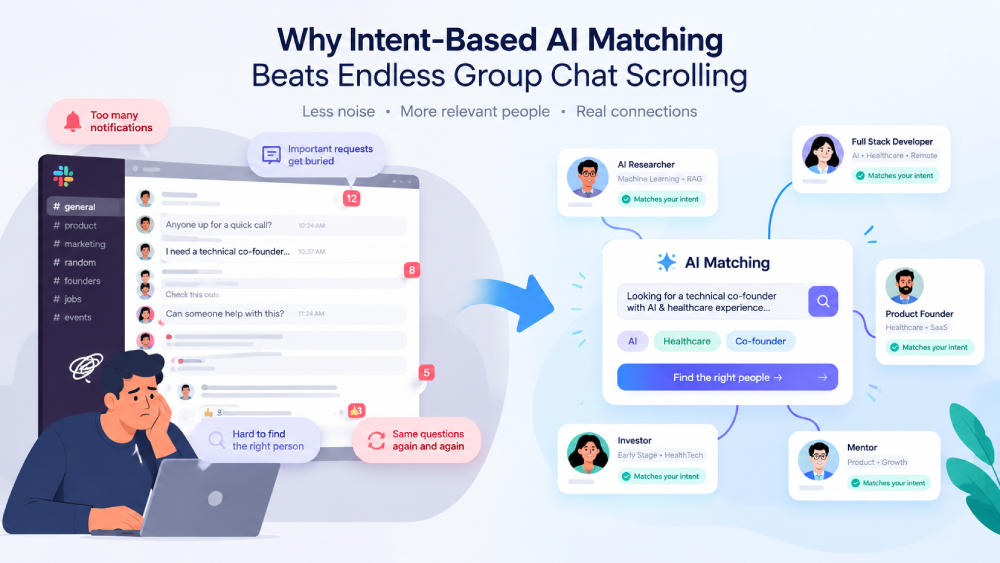
Slack and other group-chat platforms have transformed how teams communicate. But as communities grow, communication can quickly become overwhelming. Hundreds of messages, constant notifications, unrelated conversations, and unanswered requests can make it difficult to find the one person who can actually help.
This is where intent-based AI matching offers a smarter alternative. Instead of asking people to search through endless conversations, it identifies what someone needs and connects them with people who can provide the right expertise, opportunity, or collaboration.
Research has found that reducing notification-driven interruptions can improve performance and reduce strain. Even Slack has acknowledged notification overload as a significant challenge as users join more channels.
The Problem With Group Chats
A group chat is designed for conversation, not necessarily discovery. Someone might post, “I need a technical co-founder,” but the right person could be buried several messages later or may never see the post.
This creates a fundamental problem with traditional online communities: having access to hundreds of people does not automatically mean you can find the right person. Common problems include:
Slack noise created by constant messages, alerts, replies, and unrelated discussions.
Important requests getting buried under casual conversations.
Members repeatedly ask the same questions because previous answers are difficult to discover.
Valuable connections are being missed because people do not know who has the skills they need.
The issue is not that group chats are useless. They are excellent for ongoing communication. The problem is using conversation as the primary mechanism for finding people.
What Intent-Based Matching Changes
Intent-based AI matching starts with a different question: What are you trying to accomplish right now?
Instead of simply matching users according to job titles, interests, or profile keywords, an AI matching system can analyze goals, expertise, needs, projects, and complementary capabilities. For example, a founder could enter:
“I am building an AI healthcare startup and need a developer experienced in RAG and healthcare data.”
The system can identify that intent and find people whose skills and goals make them relevant. Modern AI networking platforms are increasingly using this context-first approach. Some matching systems analyze professional intent, goals, interests, and complementary skills rather than relying only on traditional profile searches.
Why Does AI Matching Beats Endless Scrolling?
Traditional community platforms depend heavily on users discovering information themselves. That means members have to search, browse profiles, read posts, monitor channels, and initiate conversations.
An intelligent matching system reverses this process. Instead of asking users to find opportunities, AI matchmaking brings relevant opportunities to them. Four major advantages stand out:
The casual outstanding is the casual key of doing the things wrong
Less noise: Users see fewer irrelevant conversations and recommendations.
Better relevance: Matches can consider goals, skills, experience, and current needs.
Faster connections: Members can move from identifying a need to meeting the right person much faster.
More meaningful engagement: People have a specific reason to connect instead of sending generic networking messages.
This makes professional networking more purposeful. The objective is no longer collecting hundreds of connections. It is finding the few people who can create meaningful value.
From Group Chat to Intelligent Communities
The future of online community management software is unlikely to be about simply adding more channels, notifications, and discussion threads. Instead, communities can become intelligent environments where AI understands member needs and helps create relevant connections. Imagine joining a founder community and immediately receiving recommendations based on your current objective:
Looking for a co-founder with technical expertise.
Searching for investors in a specific industry.
Need feedback on a new SaaS product.
Looking for an experienced mentor.
Want to collaborate with another startup.
That is where AI-powered networking becomes more powerful than conventional group communication. The community becomes an active connector rather than a passive collection of conversations.
Intent Creates Better Connections
The strongest advantage of intent-based networking is context. A traditional profile might tell you that someone is a software engineer. Intent can tell you that they are currently looking to collaborate with an early-stage founder building an AI product.
Platforms using smart matching technology can combine professional information with goals and behavioral signals to identify potentially useful relationships. Current AI networking products demonstrate how matching can move beyond keyword-based discovery toward context-aware recommendations.
Instead of:
“Who is in this group?”
The question becomes:
“Who can help me solve this problem?”
That shift can dramatically improve the value of a community.
Why This Matters for Founders and Professionals
For founders, professionals, creators, and investors, time is one of the most valuable resources. Spending hours monitoring conversations just to find one useful connection is inefficient.
AI community platforms can reduce this friction by turning scattered member information into actionable recommendations. The result is a community where:
Members discover relevant people faster.
Founders find potential collaborators without endless outreach.
Professionals receive more relevant opportunities.
Community managers can increase meaningful engagement.
Members spend less time filtering information and more time building relationships.
Group chats will still have an important role. They are useful for collaboration, announcements, social interaction, and ongoing discussions. But they should not be expected to solve every networking problem.
Conclusion
Slack and group chats solved an important communication problem, but they also created a new challenge: information overload.
Intent-based AI matching approaches the problem differently. Rather than making people search harder, it uses AI to understand what people need and identify who can help. The future of online communities is therefore not necessarily more messages. It is a better connection.
FAQs
1. What is intent-based AI matching?
Intent-based AI matching uses a person's current goals, needs, skills, and context to identify relevant people or opportunities.
2. Is AI matching better than Slack groups?
For discovering relevant connections, it can be more efficient because users do not have to search through large volumes of unrelated conversations.
3. Can AI matching replace group chats?
Not completely. Group chats are useful for ongoing communication, while AI matching is better suited to discovering relevant people and opportunities.
4. Who can benefit from AI matching?
Founders, professionals, investors, creators, mentors, communities, and organizations can use AI matching to create more relevant professional connections.
Get the next article in your inbox
Stay updated with practical insights, product updates, and networking tips — delivered straight to your inbox.
