Technology is changing the way businesses and event organizers display information. From digital signage to smart event credentials, electronic displays are replacing many traditional printed materials. One increasingly useful example is the E-Ink badge, a reusable digital badge that uses electronic paper technology to display names, roles, logos, and other information.
Unlike conventional screens, an electronic paper badge is designed to look similar to printed paper. It consumes very little power and can maintain an image even when the device is not actively receiving power. These characteristics make E-Ink badges particularly useful for conferences, exhibitions, corporate events, offices, and other environments where information needs to be displayed clearly and updated regularly.
But how does E-Ink technology actually work, and what makes it different from traditional digital displays?
What Is an E-Ink Badge?
An E-Ink badge is a digital identification badge that uses E-Ink display technology, also known as electronic paper or e-paper. Instead of using a conventional LCD or LED screen, the badge uses tiny particles inside the display to create visible text and images. A typical badge may display information such as:
Attendee name and job title
Company name and logo
Event branding
QR codes
Exhibitor or speaker status
Room or session information
Because the display resembles printed paper, it can remain readable under bright lighting and different viewing conditions. The badge can be updated electronically whenever the information changes. This makes it possible to reuse the same physical badge for different attendees, events, roles, or purposes.
How Does E-Ink Technology Work?
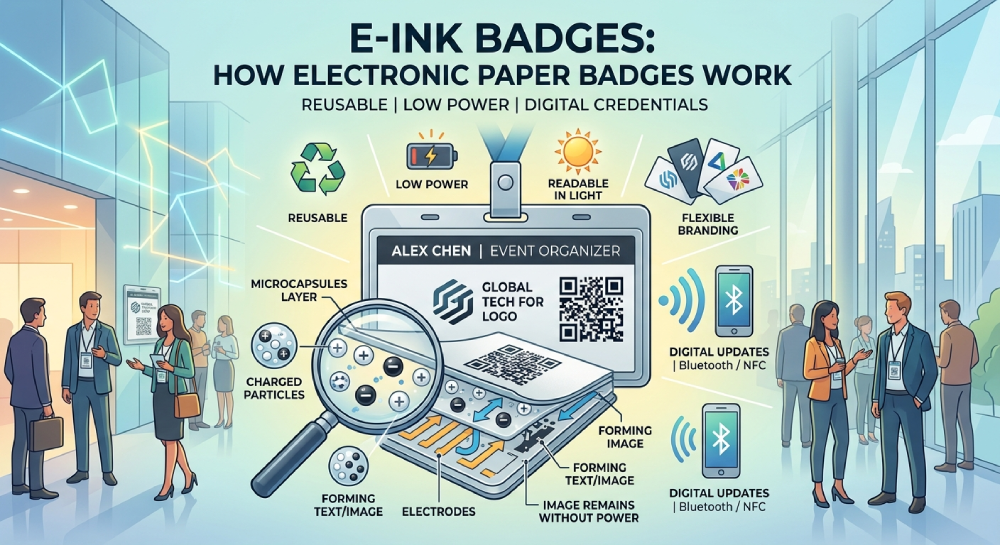
The basic principle behind electronic ink technology is quite different from the technology used in smartphones and computer monitors. An E-Ink display contains extremely small capsules or particles. These particles have different electrical properties and colors. When an electrical charge is applied, the particles move within the display to create the required text or image.
Once the particles have moved into position, they can remain there without continuously consuming electricity. This is one of the most important characteristics of E-Ink displays. Power is generally needed when the displayed content changes rather than continuously to maintain a static image.
For example, if an attendee's name is displayed on an E-Ink event badge, the badge can continue showing that name without constantly using battery power. When the attendee information needs to change, the display receives a new electronic instruction.
Why Do E-Ink Badges Use Less Power?
One of the biggest advantages of E-Ink technology is its low energy consumption. Traditional digital screens usually require continuous power to keep displaying content. E-Ink works differently. Once an image has been updated, the display can retain that image without constantly refreshing it.
This means an E-Ink name badge can potentially operate for long periods on a small battery, depending on the device design, wireless technology, update frequency, and battery capacity. For event organizers, this can be useful because badges may need to display the same information for several hours or even multiple days.
Low power consumption also makes E-Ink suitable for reusable badges where battery replacement or frequent charging would be inconvenient.
E-Ink vs Traditional Digital Displays
E-Ink badges and traditional digital displays are designed for different purposes. LCD and LED displays are excellent for video, animation, bright colors, and rapidly changing content. However, they generally consume more power and may be less comfortable to read in direct sunlight.
An E-Ink badge, on the other hand, is designed primarily for static or occasionally changing information. Its key characteristics include:
Paper-like readability
Very low power consumption
Excellent visibility in bright light
Minimal glare compared with many conventional displays
Ability to retain an image without continuous power
How E-Ink Event Badges Work?
E-Ink event badges typically combine the display with a small electronic system that allows organizers or event platforms to update attendee information.
Depending on the product, an electronic badge may communicate through wireless technologies such as Bluetooth, NFC, Wi-Fi, or another proprietary system.
Before an event, organizers can assign information to individual badges. If an attendee changes their company, job title, role, or event category, the information can potentially be updated digitally rather than printing an entirely new badge.
For large conferences, this can simplify badge management considerably. Instead of printing thousands of badges and discarding them when information changes, organizers can use reusable digital badges that can be updated when required.
Benefits of E-Ink Badges for Events
E-Ink badges can provide several practical benefits for event organizers and attendees.
Reduces disposable badge waste: Reusable E-Ink badges can be used across multiple events or sessions, reducing the need to print and discard new badges each time.
Simplifies badge management: Digital updates allow organizers to change attendee information without manually printing and replacing badges, reducing administrative work.
Provides excellent readability: The paper-like E-Ink display remains clear and easy to read without requiring a bright, continuously powered screen.
Offers flexible branding: Organizers can update company names, event logos, attendee roles, and other approved information without creating an entirely new physical badge.
Are E-Ink Badges Environmentally Friendly?
The environmental impact of an electronic paper badge depends on how it is manufactured, used, maintained, and eventually disposed of. However, reusable badges can reduce the number of single-use printed credentials required for recurring events.
For organizations that hold frequent conferences, exhibitions, or corporate meetings, repeatedly printing and discarding thousands of badges can create unnecessary material waste. A reusable digital event badge can be designed for multiple uses, potentially reducing paper, printing materials, and disposal requirements over its service life.
However, organizers should also consider battery disposal, electronic components, manufacturing impacts, and end-of-life recycling when evaluating the overall environmental benefits.
Common Applications of E-Ink Badges
Although events are an important use case, E-Ink badges can have applications beyond conferences.
They can be used for employee identification, visitor management, exhibitions, trade shows, networking events, educational institutions, and professional gatherings.
For example, an office could use reusable digital employee badges where names and roles can be updated when staff members change positions. Similarly, an exhibition could provide exhibitors with badges that display company information and event-specific branding. The technology can also support situations where information needs to remain visible for long periods without requiring a continuously active screen.
What is the Future of Electronic Paper Badges?
As event technology becomes more connected, E-Ink badges could become part of larger digital event ecosystems. Instead of functioning only as identification tools, future smart E-Ink badges may integrate with registration platforms, access control systems, networking applications, and attendee management software.
However, the right solution depends on the event's requirements. Organizers should consider display size, connectivity, battery life, update frequency, security, durability, integration capabilities, and total cost before selecting a badge system.
Conclusion
E-Ink badges offer a practical combination of digital functionality and paper-like simplicity. By using electronic ink rather than a conventional illuminated display, these badges can show information clearly while consuming very little power when content remains unchanged.
For conferences, exhibitions, corporate environments, and other professional settings, electronic paper badges can make information easier to update while supporting reusable and more flexible identification systems.
FAQs
1. What is an E-Ink badge?
An E-Ink badge is a reusable digital badge that uses electronic paper technology to display information such as names, company details, roles, logos, and QR codes.
2. How does an E-Ink display work?
An E-Ink display uses electrically controlled particles to create text and images. Once the particles move into position, the display can retain the image without continuously using power.
3. Do E-Ink badges need batteries?
Most electronic badges require some form of power to update their displays and operate their electronic components. However, E-Ink itself consumes very little power when displaying a static image.
4. Can E-Ink badges be reused?
Yes. One of the main advantages of reusable digital badges is that their displayed information can be updated electronically, allowing the same physical badge to be used for different people or events, depending on the system's design.
Get the next article in your inbox
Stay updated with practical insights, product updates, and networking tips — delivered straight to your inbox.