Smart Badge Security: Privacy, Access Control & Data Protection`
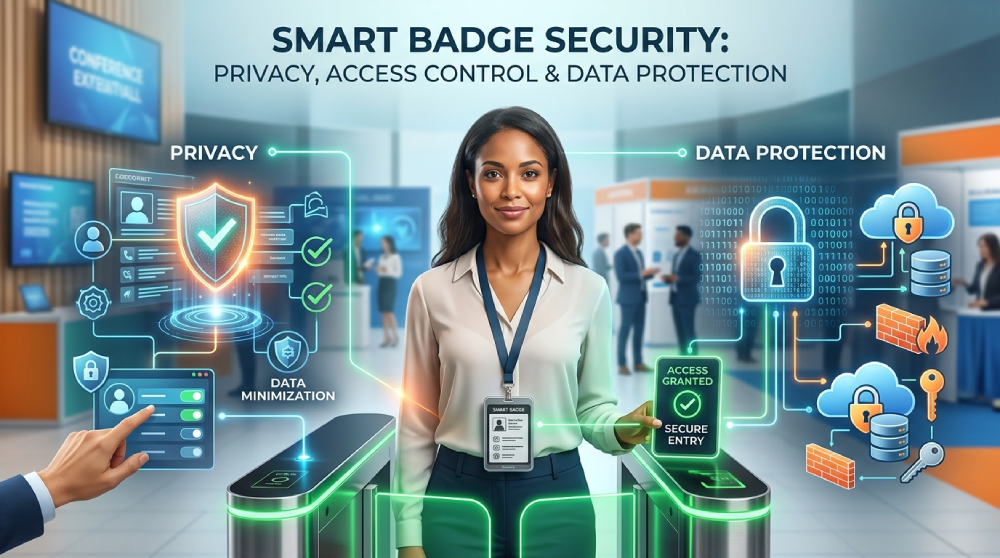
Smart badges have transformed traditional event credentials into connected digital tools. Instead of simply displaying a person's name and organization, a modern smart badge can support check-in, networking, access control, attendance tracking, and digital information sharing. However, as badges become more connected, smart badge security becomes an important consideration for event organizers, businesses, schools, and other organizations.
A smart badge may process information such as an attendee's name, company, job title, registration details, or access permissions. Depending on the technology and event platform, it may also interact with scanners, mobile applications, or access-control systems. Protecting this information requires careful planning around privacy, authentication, data storage, and user permissions.
What Information Can Smart Badges Collect?
The amount of information collected by a smart badge system depends on its design and intended purpose. A basic badge may only display identification details, while a connected system may collect information related to event participation. Potential data can include:
Name and professional information
Registration and attendance records
Access permissions
Networking interactions
Booth or session visits
Digital profile information
Badge scan records
Not every system needs to collect all of this information. A good security strategy begins with data minimization, meaning organizations should collect only the information necessary for a specific purpose. For example, if a badge only needs to confirm access to an exhibition hall, collecting detailed networking activity may not be necessary.
Privacy and Smart Badges
Privacy should be considered before deploying any connected smart badge system. Attendees should understand what information is being collected, why it is being collected, and how it will be used.
Clear privacy notices can help attendees make informed decisions. Where applicable, organizations should also provide appropriate consent mechanisms and explain whether information will be shared with exhibitors, sponsors, event partners, or other third parties. Privacy policies should also address how long information will be retained. Data that is no longer required should not necessarily remain stored indefinitely.
For organizations operating across different countries, privacy requirements can vary by jurisdiction. Event planners should therefore review applicable data-protection obligations before collecting or processing attendee information.
Access Control with Smart Badges
One of the most useful security applications of smart badges is access control. Different participants may need different levels of access during an event. For example, a conference could assign separate permissions to:
General attendees
Speakers
Exhibitors
VIP guests
Event staff
Contractors
A smart badge can be linked to a participant's assigned permissions. When the badge is scanned at a controlled entrance, the system can determine whether the person is authorized to enter that area.
This approach can make access management more organized than relying entirely on visual identification. However, access permissions should be carefully configured. Users should receive only the access necessary for their role, and permissions should be reviewed when roles change.
Protecting Smart Badge Data
Data protection involves more than securing the physical badge. The complete technology ecosystem should be considered, including badge hardware, scanners, event applications, servers, databases, and administrative accounts.
Organizations should use appropriate security controls throughout the system. Depending on the solution, these may include encryption, secure authentication, access restrictions, software updates, and monitoring.
Administrative access is particularly important. Event systems may contain sensitive attendee information, so staff accounts should be protected with strong authentication and appropriate permission levels. If an employee or contractor no longer requires access to the system, their credentials should be removed or disabled promptly.
Secure Networking and Data Sharing
Smart badges are increasingly used for networking. Attendees may scan or tap badges to exchange professional contact information. While convenient, this functionality should give users control over what they share.
A networking system can allow attendees to choose which information is visible, such as their name, company, email address, or professional profile. This is preferable to automatically exposing more information than necessary.
Organizations should also explain whether information exchanged through networking features is stored by the event platform and whether exhibitors or sponsors can access it.
Protecting Lost or Stolen Badges
Physical security remains important even when a badge contains sophisticated technology. If a smart badge is lost or stolen, organizers should have a process for deactivating or replacing it. This is especially important when the badge provides access to restricted areas.
For example, if a staff badge provides access to operational rooms, simply issuing a replacement without disabling the original could create an unnecessary security risk. A centralized event badge system can make it easier for authorized administrators to deactivate credentials when necessary.
Secure Use of QR, NFC, and Bluetooth
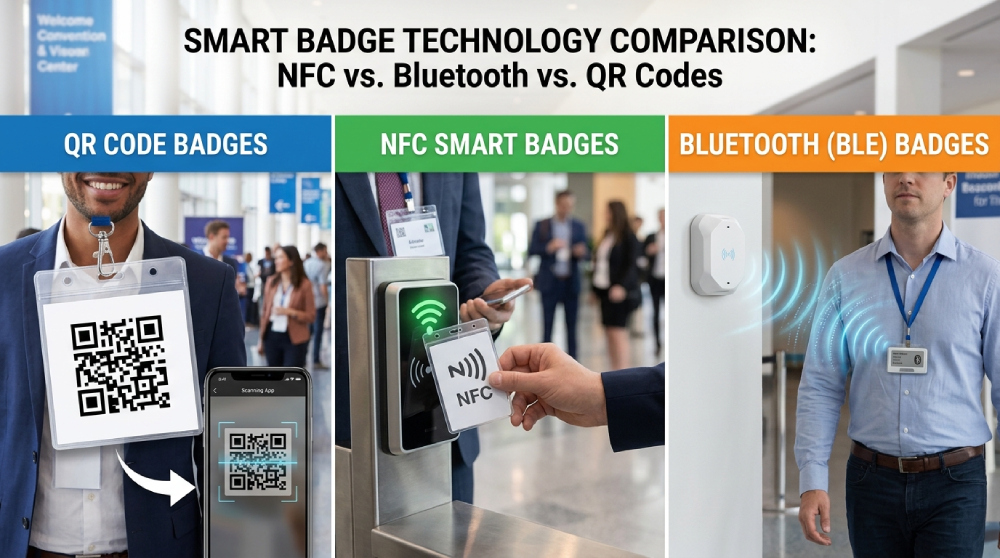
Different smart badge technologies have different security considerations. QR codes can direct users to digital profiles or event information, but organizations should ensure that linked destinations are legitimate and secure.
NFC can enable convenient contactless interactions, but the implementation should protect information stored or transmitted through the system. Bluetooth-enabled badges can provide more advanced wireless functionality, but they require appropriate configuration, device management, and communication security. The technology itself is only one part of the security model. How the complete system is configured and managed is equally important.
Building a Safer Smart Badge System
A secure badge program should combine technology, policies, and staff procedures. Before an event begins, organizers should determine what information is necessary, who can access it, and how long it will be retained.
They should also test badge deactivation, access permissions, data-sharing settings, and emergency procedures. Staff members who operate the system should understand basic privacy and security requirements. Attendees should receive clear information about networking and data collection features.
Conclusion
Smart badges can make events more convenient and connected, but their benefits should be balanced with responsible data protection. Effective smart badge security requires attention to privacy, access control, secure data handling, authentication, and physical credential management.
The safest approach is not simply to collect as much information as possible. Instead, organizations should determine what information is genuinely required and build appropriate safeguards around it.
Get the next article in your inbox
Stay updated with practical insights, product updates, and networking tips — delivered straight to your inbox.